
Vehicle concepts for recyclable low-speed vehicles for urban supply and waste collection (FaNK)
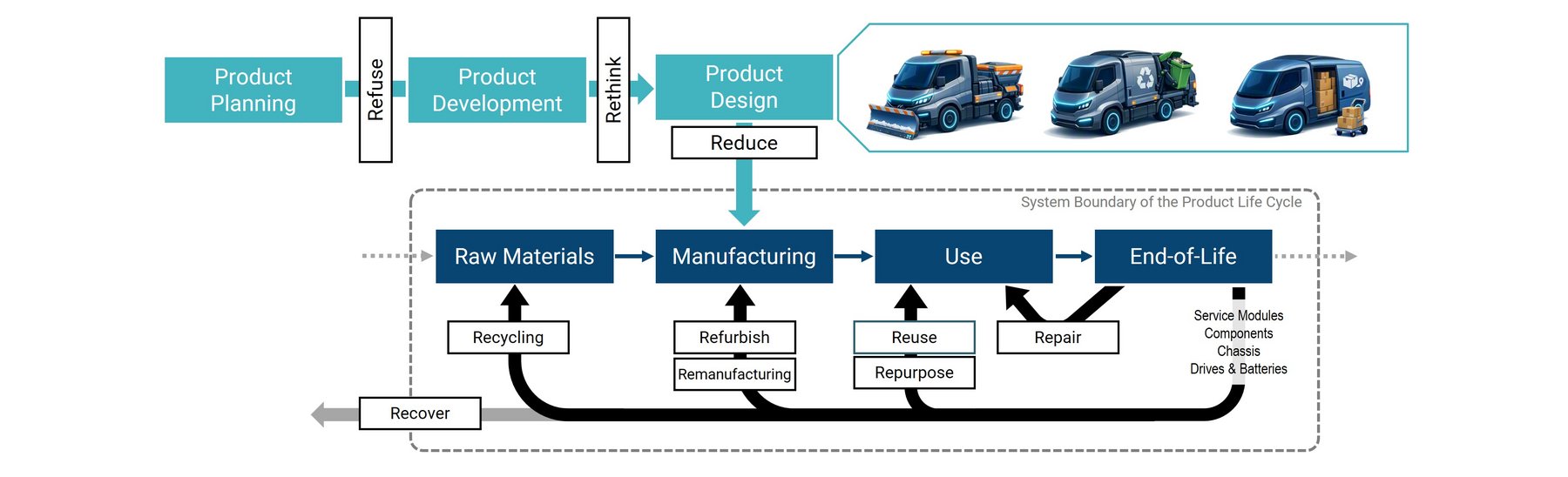
Growing urban mobility and logistics needs are increasingly coming up against environmental and economic constraints, whilst the vehicles required for these purposes themselves consume significant resources. Circular economy approaches and life-cycle-oriented concepts offer potential here for resource-efficient solutions. Against this backdrop, the focus is shifting towards innovative, circular vehicle concepts and new solutions for the transport of people and goods – in particular, electric, compact, low-speed vehicles that are modular and semi-autonomous, and can be flexibly adapted to different requirements in the field of urban supply and waste management. However, existing vehicle concepts are often still based on linear value creation models. For sustainable urban mobility, new design approaches, flexible usage options and the further development of technologies for implementing R-strategies (including Reuse, Remanufacture and Recycle) are therefore necessary in order to fully integrate vehicles into material cycles.
What are the project participants’ objectives?
The FaNK project therefore addresses both the circularity of future, innovative vehicles and their use within the urban circular economy. The focus is on developing and testing concepts for digitally innovative, circular low-speed vehicles – including those with an automated driving mode – which are specifically designed for the transport of materials within urban supply and waste management cycles. The emphasis is on measures to increase resource efficiency, promote the use of secondary materials and develop new business models designed to capitalise on the potential economic benefits of a circular economy. The project is designed as a collaborative initiative between the Technical University of Braunschweig and Ostfalia University of Applied Sciences, whose research work will be consolidated into a joint concept and demonstrator as the overall project outcome.
The project is being funded for the period from 1 November 2026 to 30 April 2029 by the European Regional Development Fund (ERDF) and the State of Lower Saxony.

Project Management
M. A. Lisa Klatt
Building C, Room 107 A, Wolfsburg
Prof. Dr.-Ing. Max Juraschek
Building C, Room 103, Wolfsburg